
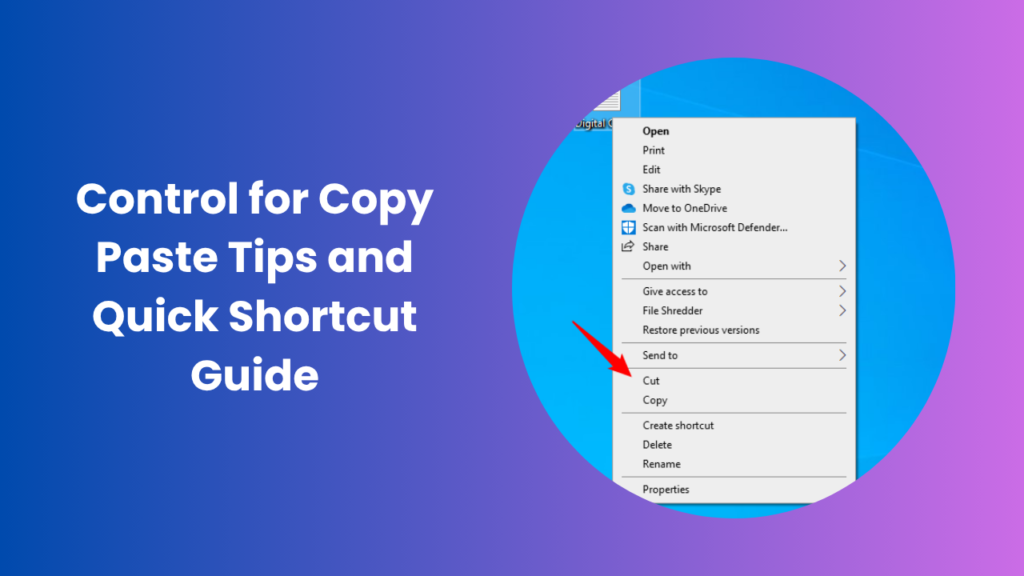
In today’s fast-paced digital environment, efficiency is more than a convenience, it is a necessity. From students working on assignments to professionals preparing reports or designers building creative projects, the ability to perform everyday tasks quickly can have a significant impact on productivity. Among the countless functions available in computing, copy and paste remain the most frequently used and universally understood. Whether you are transferring text, duplicating code, or moving files, the shortcut that uses control for copy paste has become a cornerstone of digital interaction.
What makes this combination so powerful is its simplicity. Just two keystrokes allow users to move content across applications, documents, and platforms in a fraction of a second. This time-saving action is so deeply ingrained in our habits that many people cannot imagine working without it.
The Origins of Copy and Paste
Copy and paste as a concept was first introduced in the 1970s when computer scientists were exploring more intuitive ways for humans to interact with machines. The revolutionary work of Larry Tesler at Xerox PARC popularized the command, and it soon became an indispensable tool in word processors and graphic design software. Early systems required long commands or menus, but with the advent of graphical user interfaces, the shortcut keys we know today became standard. By the time Microsoft Windows and Apple Macintosh took off in the 1980s and 1990s, users had fully embraced these commands as part of their daily interactions with technology.
Why Keyboard Shortcuts Matter
Keyboard shortcuts might appear small, but they significantly reduce the time it takes to complete tasks. Instead of reaching for the mouse, navigating through menus, and clicking several options, a single key combination can perform the same job in less than a second. This not only speeds up workflow but also reduces repetitive strain caused by constant mouse use. For professionals who work with large amounts of text, code, or data, shortcuts are more than just conveniences; they are productivity boosters.
Efficiency in Office Work
In environments where employees are writing reports, preparing presentations, or analyzing data, being able to quickly copy and paste large chunks of information streamlines the entire process. A journalist writing multiple articles a day or a data analyst transferring values between spreadsheets can shave off hours of manual effort simply by relying on keyboard shortcuts.
Benefits for Students and Researchers
Students working on essays or research papers also benefit greatly. Rather than rewriting long passages of citations or notes, the ability to copy and paste helps them focus on actual analysis and critical thinking rather than manual repetition. However, this also requires ethical use, as plagiarism is a major concern.
How Shortcuts Differ Across Platforms
While the concept remains universal, the exact keys used to perform copy and paste vary depending on the operating system and device. On Windows and Linux computers, the Control key is used in combination with the letter C for copy and V for paste. On Apple’s macOS, the Command key replaces Control, though the logic remains the same. Mobile devices add another layer of variation, where long presses and touch gestures replace physical keys.
The Psychology of Shortcut Placement
One interesting fact about shortcut design is that the chosen letters often have little to do with the action itself. For example, V was selected for paste not because of any obvious meaning but because of its convenient placement next to C and X on the keyboard. These three keys cut, copy, and paste form a cluster that users can perform with one hand, making them practical and ergonomic.
Exploring the Science of Muscle Memory
When a shortcut is used regularly, the brain and body form a type of muscle memory. This is why experienced typists can execute shortcuts almost unconsciously. Once ingrained, these movements require minimal thought, which explains why breaking habits—such as switching from Windows to Mac can be frustrating at first. The human brain prefers routine, and shortcuts leverage this cognitive tendency to enhance efficiency.
Common Mistakes Users Make
Even though copy and paste are simple actions, mistakes still occur. A frequent issue is accidentally overwriting important information without realizing it, especially in documents or spreadsheets. Another common problem is pasting content without formatting, which often leads to broken layouts or inconsistent fonts. Many users are also unaware that advanced paste options exist, such as pasting values only in spreadsheets or pasting unformatted text in word processors.
Advanced Features in Modern Applications
Modern software has expanded the functionality of copy and paste well beyond the basic shortcut. For example, advanced text editors and coding environments allow multiple clipboard entries to be stored and accessed. Applications like Microsoft Word and Excel provide options to paste with formatting, without formatting, or even using special mathematical or table structures. Some operating systems even maintain a clipboard history, enabling users to access items copied hours or even days earlier.
The Role of Cloud-Based Clipboards
Cloud synchronization has made copy and paste even more powerful. With services like Microsoft’s Cloud Clipboard or Apple’s Universal Clipboard, users can copy something on one device and paste it instantly on another. This is especially useful for people who use multiple devices during the day, such as moving text from a laptop to a phone without emailing it to themselves.
The Main Role of Control for Copy Paste
When examining why the control key became the standard for shortcuts, ergonomics and keyboard design play key roles. The Control key sits conveniently at the bottom corner of most keyboards, easy to reach with the pinky finger. By pairing it with central letters like C, V, and X, designers ensured that users could execute commands quickly without shifting hand positions too much. This simple placement decision has made the combination one of the most universally learned commands across all computer systems.
Practical Applications in Professional Workflows
Copy and paste go far beyond moving text from one location to another. In programming, developers use it to transfer code snippets, debug errors, or duplicate structures. In creative fields, designers rely on it for duplicating elements across layers or projects. Even in healthcare, professionals use it for managing patient records efficiently. The universality of this function proves its importance across nearly every sector.
The Ethical Side of Copy and Paste
With power comes responsibility. While copy and paste enable efficiency, they also make it easier to misuse information. For example, plagiarism in academic work or unauthorized duplication of proprietary code are ongoing issues. Responsible use means giving credit where it is due and understanding the difference between efficiency and intellectual theft.
Future of Copy and Paste Technology
Looking forward, artificial intelligence is likely to enhance how copy and paste works. Instead of simply transferring raw data, future systems may interpret and adapt copied content based on context. Imagine copying a table from a website and pasting it into a document where it automatically reformats itself into your preferred style. AI-driven smart paste functions are already emerging in tools like Google Docs and Microsoft Word, where formatting suggestions appear automatically.
FAQs
Why was Ctrl + V chosen as the shortcut for paste?
The letter V does not represent the word paste directly. Instead, it was chosen because it sits next to C (for copy) and X (for cut) on the keyboard, making the three shortcuts easy to use together with one hand..
How does copy and paste work on mobile devices?
On smartphones and tablets, copy and paste are typically performed by tapping and holding on text until selection markers appear. A contextual menu then allows the user to copy or paste the content. While the process is slower than a keyboard shortcut, touch gestures make sense in environments without physical keys.
Can copy and paste store multiple items at once?
Yes. While the traditional clipboard only remembers one item at a time, modern systems like Windows 10 and 11, macOS, and many third-party apps now allow multiple clipboard entries.
What is the difference between paste with formatting and paste without formatting?
Pasting with formatting preserves the fonts, colors, and layouts of the original text. Pasting without formatting strips these details and applies the destination’s default style. The latter option is useful when merging content into documents where consistent formatting is required.
Is it safe to copy and paste passwords?
While convenient, copying and pasting passwords can pose security risks. If your clipboard history is stored or synced, sensitive information could be exposed. Security experts recommend using password managers instead, as they provide safer ways to autofill login details without exposing them to the clipboard.
Why is copy and paste considered a revolutionary feature?
Copy and paste transformed digital workflows by reducing repetitive effort. Before its introduction, transferring content required manual re-entry, which was time-consuming and error-prone.
Conclusion
While technology has advanced dramatically over the past few decades, some tools have remained timeless because of their effectiveness. Copy and paste is one of those tools. It began as a simple solution for avoiding repetitive typing, but it quickly became one of the most universal shortcuts in modern computing. Today, its influence extends far beyond word processors, impacting fields such as education, programming, design, business, and even healthcare. The ease of using control for copy paste demonstrates how thoughtful design can shape daily productivity, bridging the gap between human needs and machine efficiency.
What makes this feature especially remarkable is its adaptability. As new platforms and devices emerge, the underlying principle remains the same, allowing users to work seamlessly across desktops, laptops, and mobile environments. The addition of cloud clipboards and AI-driven smart paste features points toward a future where the action will not only transfer content but also enhance it intelligently.